Any questions? Give us a call 05 - 375 3220
Free delivery for orders over 1000 € / 30 days Return policy
Any questions? Give us a call 05 - 375 3220
Free delivery for orders over 1000 € / 30 days Return policy
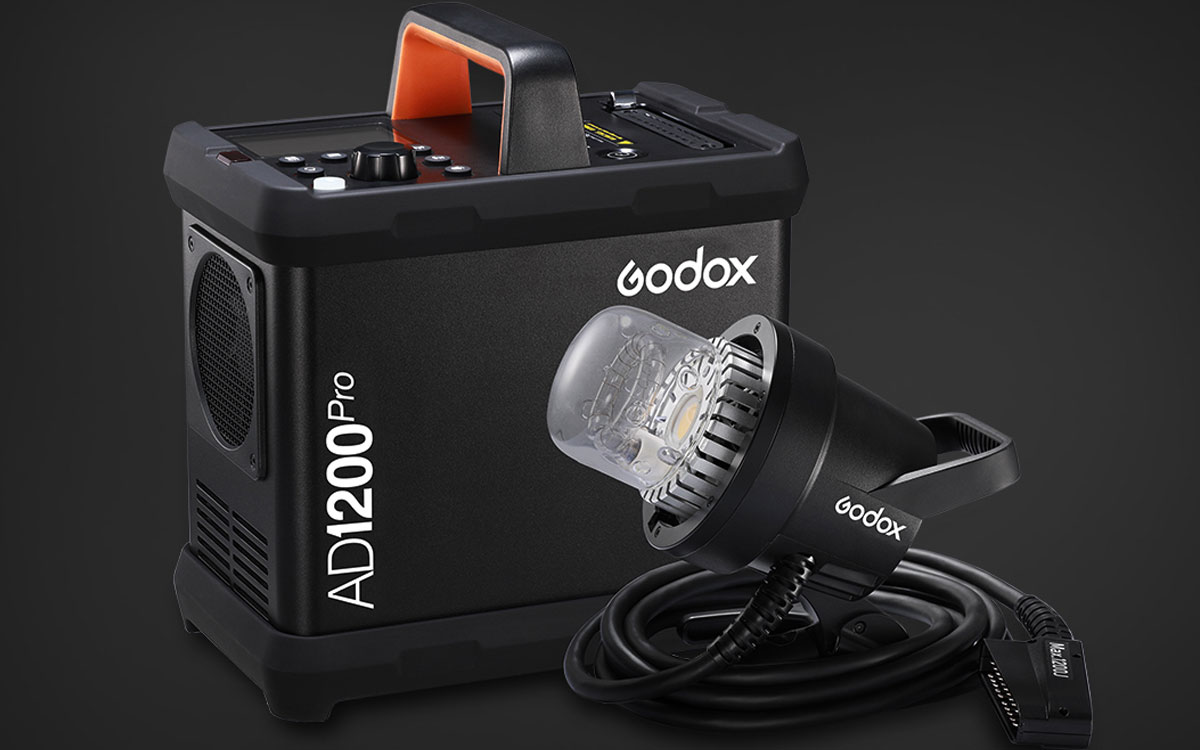
A battery-powered flash is a hybrid between a shoe-mounted flash and a studio flash: it has the power of a studio flash but operates without mains power. Godox’s AD series battery-powered flashes are the most popular choice amongst wedding photographers, portrait photographers and home studios, as they are powerful, affordable and work with all camera brands via the same wireless system. In this comparison, we’ll be looking at the entire range, from the 100 Ws pocket flash to the 1200 Ws field flash, and we’ll explain which model is best suited to which application and which transmitter is used to control them.
| Model | Power | Flashes at full power | Download time | Printed from | Fixing | TTL |
|---|---|---|---|---|---|---|
| AD100 Pro II | 100 Ws | approx. 490 | 0.01–1.5 s | approx. 0.5 kg | Round head, magnetic accessories | Yes |
| AD200 Pro II | 200 Ws | approx. 500 | 0.01–1.8 s | approx. 0.9–1.0 kg | Interchangeable flash heads | Yes |
| AD300 Pro II | 300 Ws | approx. 350 | 0.01–1.5 s | approx. 1.2 kg | Godox mount, with Bowens adapter | Yes |
| AD400 Pro II | 400 Ws | approx. 460 | 0.01–1.0 s | approx. 2.0 kg | Godox mount, Bowens adapter included | Yes |
| AD600BM II | 600 Ws | approx. 500 | 0.01–1.9 s | approx. 2.9 kg | Bowens | No, manual |
| AD600 Pro II | 600 Ws | approx. 360 | 0.01–0.9 s | approx. 3.0 kg | Bowens | Yes |
| AD800 Pro | 800 Ws | approx. 300 | 0.01–1.5 s | approx. 3.7 kg | Bowens | Yes |
| AD1200 Pro | 1,200 Ws | approx. 400–500 | approx. 1.5–2 s | Separate head and battery unit | Bowens | Yes |
The information is provided by the manufacturer. The weight is stated including the battery, and the manufacturer measures it slightly differently for different models (for example, with or without the reflector).
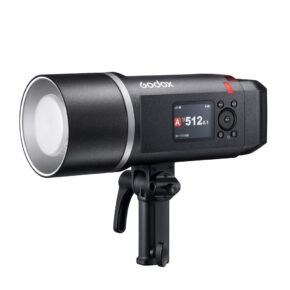
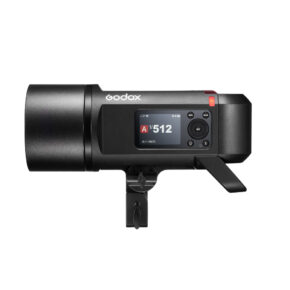
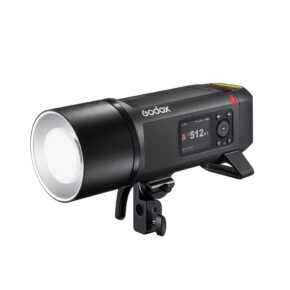
Flash power is measured in watt-seconds (Ws). A shoe-mounted flash typically has a power output of around 60–80 Ws, so even the AD200 is clearly more powerful. In photography, power is expressed in f-stops: Double the power provides one stop more light. The AD400 is therefore more powerful than the AD200, and the AD800 is more powerful than the AD400.
It’s not worth buying too much power: a larger flash is also heavier to carry, and at the lowest power setting, a smaller flash is often more practical. For many people, the best solution is two smaller flashes rather than one large one.
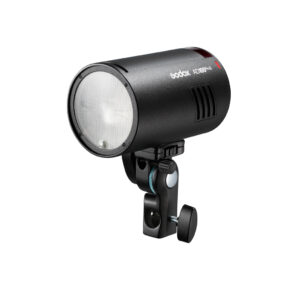
AD100 Pro II It’s only slightly larger than a shoe-mounted flash, but it has 100 Ws of power and a round flash head that distributes the light evenly. The battery provides around 490 full-power flashes, and the 5 W LED modelling light allows you to see the direction of the light before taking the shot. The Pro II version features a colour display, a group colour indicator light and quick pairing with the X3 transmitter.
Okay: as a secondary light source for weddings and events, for travel, and for photographers who do a lot of walking. The same magnetic adapters are also compatible with the Godox V1 hot-shoe flash.
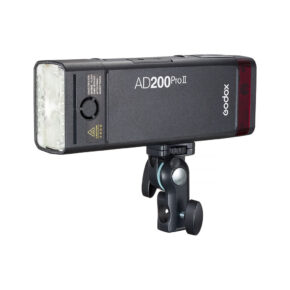
AD200 Pro II is the most versatile model in the range. It features two interchangeable flash heads: a hot-shoe-style head for directional lighting and a bare flash tube that distributes light evenly into a softbox or umbrella. It has an output of 200 Ws, and at full power the battery provides around 500 flashes. In the Pro II version, the power can be adjusted down to 1/512, and both flash heads feature a dual-colour LED modelling light.
Okay: Ideal as a first battery-powered flash, for wedding photographers, for outdoor portraits in the shade or in cloudy weather, and for a small home studio. Two AD200s fit into a small bag and are sufficient for most shoots.
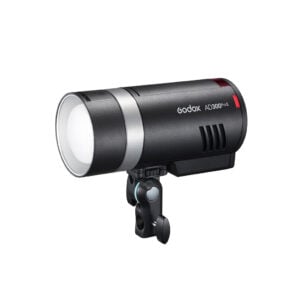
AD300 Pro II It is a 300 Ws flash that weighs only about 1.2 kilograms, including the battery. This makes it popular for outdoor photography, where the flash is mounted high on a tripod or light arm. Softboxes and other modifiers attach directly to the flash, so no separate mounting bracket is required. The Pro II version features a 12 W dual-colour modelling light, a short flash duration for freezing motion, and HSS up to 1/8000 s.
Okay: for outdoor photography, when the AD200 isn’t powerful enough but the AD600 is too heavy, as well as for portrait photographers on the move.
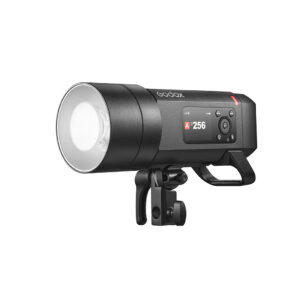
AD400 Pro II It is the fastest in the range: the charging time at full power is only about a second, and the battery provides around 460 full-power flashes. A bright 30 W two-colour modelling light helps with focusing in low light and shows how the light will fall. The pack includes a Bowens adapter, so the flash is compatible with all Bowens-mount softboxes.
Okay: For a portrait photographer who shoots both in the studio and outdoors, and as the main flash for a home studio.
AD600 Pro II It is one of the most popular battery-powered flashes used by professionals. Its 600 Ws output is sufficient to overpower sunlight, and the recharge time at full power is less than a second. The flash features a direct Bowens mount and a 40 W dual-colour modelling light. The Pro II version features a redesigned colour display, a group colour indicator light and quick pairing with the X3 transmitter.
AD600BM II is the more affordable manual version. It doesn’t have TTL automation, but it offers the same power output and the battery provides up to around 500 full-power flashes. If you always adjust the flash output yourself, the BM II is a good way to get 600 Ws at a lower price.
Okay: for portrait photography in sunlight, sports and equestrian photography, and when using large light-modifying accessories.
AD800 Pro is Godox’s latest battery-powered flash. At 800 Ws, it offers a third more power than the AD600, yet the flash consists of a single, integrated body with no separate battery unit. In Freeze mode, the flash duration is as short as approximately 1/35,000 s, which freezes even the fastest motion, such as splashing water or a leaping athlete. The battery provides around 300 full-power flashes, and the direct Bowens mount is compatible with all Bowens modifiers.
Okay: For photographers for whom the AD600’s power is insufficient, but who find the AD1200’s separate battery pack too heavy to carry.
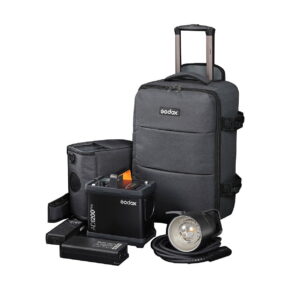
AD1200 Pro is the most powerful model in the range. It features a separate battery unit and a cable-connected flash head, so only the lightweight head is mounted on the tripod. The 1200 Ws output is sufficient for large softboxes and group shots, even in bright sunlight. The flash can also be fitted with a ring flash head and a mains adapter, allowing it to function in the studio just like a standard studio flash.
Okay: for professionals who take advertising, fashion or group photographs on location using a large light source.
The battery-powered flash is controlled wirelessly via a transmitter fitted to the camera’s hot shoe. All AD flashes come with a built-in Godox 2.4 GHz X-system receiver, so no separate receiver is required. Using the transmitter, you can adjust the power and groups of all the flashes from the camera up to a distance of approximately 100 metres. The transmitter is chosen according to your camera brand, but the flash itself is compatible with all brands.
A Godox hot-shoe flash, such as the V1 Pro or V860 III, can also act as a transmitter. In this case, the flash mounted on the camera both illuminates the scene and controls the battery-powered flashes. We compared Godox’s hot-shoe flashes separately in an article A comparison of Godox flashes. You can find all the transmitters in the department transmitters.
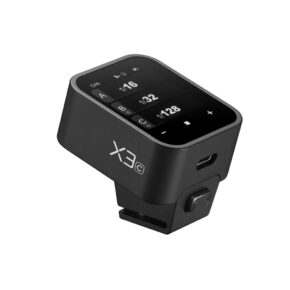
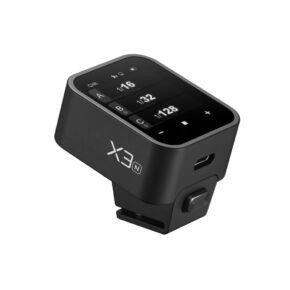
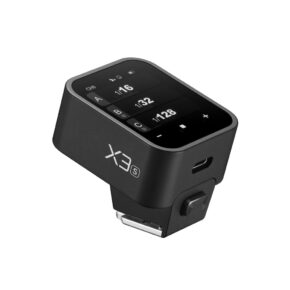
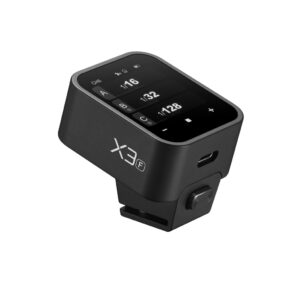
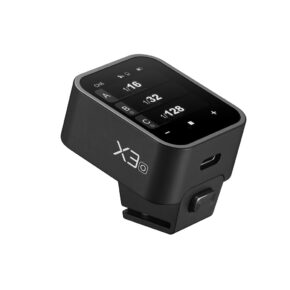
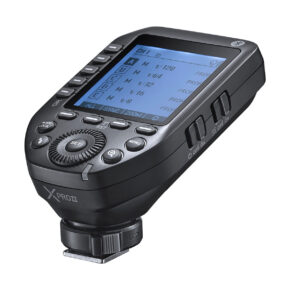
A bare flash produces harsh light and sharp shadows. For soft portrait lighting, you’ll need a softbox or an umbrella. The AD300 Pro and AD400 Pro flashes have their own lightweight parabolic softboxes that attach directly to the flash. The AD600, AD800 and AD1200 models feature a Bowens mount, so they are compatible with all Bowens-mount accessories.
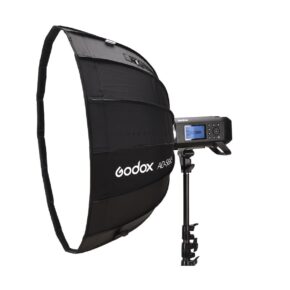
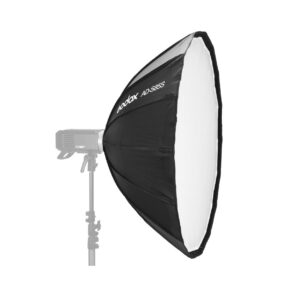
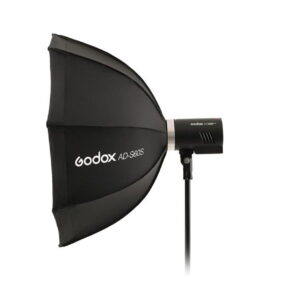
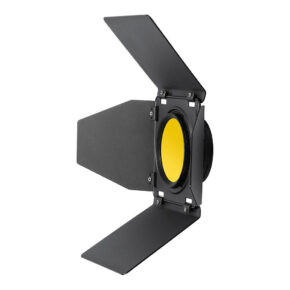
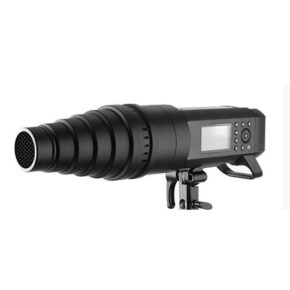
You can find more modifiers in the section photomodifiers and all the battery-powered torches from the department battery storage.
We often receive Godox battery-powered flashes through our trade-in scheme, and you can get a used AD200 Pro or AD600, for example, at a significantly lower price than a new one. We check that every flash is in working order, and all second-hand equipment comes with a minimum 90-day warranty and a 30-day right of return. See Second-hand Godox products.
For most people, the best choice is the AD200 Pro II: it’s lightweight, powerful enough for indoor use and in the shade, and the interchangeable flash heads make it versatile. If you do a lot of outdoor photography in sunlight, go for the AD600 Pro II or the AD400 Pro II.
The AD300 Pro II is about half a stop more powerful, and the softboxes attach directly to the flash. The AD200 Pro II is lighter and features interchangeable flash heads. Choose the AD200 if compact size is your priority, and the AD300 if you mainly use the flash with a softbox.
TTL automatically adjusts the flash output, which speeds up shooting in situations where the distance to the subject changes, such as at weddings. In the studio and for staged portraits, the power is usually adjusted manually, in which case a manual flash, such as the AD600BM II, is perfectly adequate.
It works. The flash itself isn’t tied to a specific camera brand; instead, the brand is selected according to the transmitter. Godox transmitters are available for Canon, Nikon, Sony, Fujifilm, OM System, Panasonic and Leica.
Some models are available with an optional mains power adapter, which replaces the battery. The adapter is available, for example, for the AD600 Pro and AD1200 Pro. In the studio, the adapter eliminates the need to charge the battery altogether.
Welcome to our shop in Kouvola. You can try out the flashes and transmitters with your own camera, and we’ll help you choose the right model and lighting accessories.