Any questions? Give us a call 05 - 375 3220
Free delivery for orders over 1000 € / 30 days Return policy
Any questions? Give us a call 05 - 375 3220
Free delivery for orders over 1000 € / 30 days Return policy
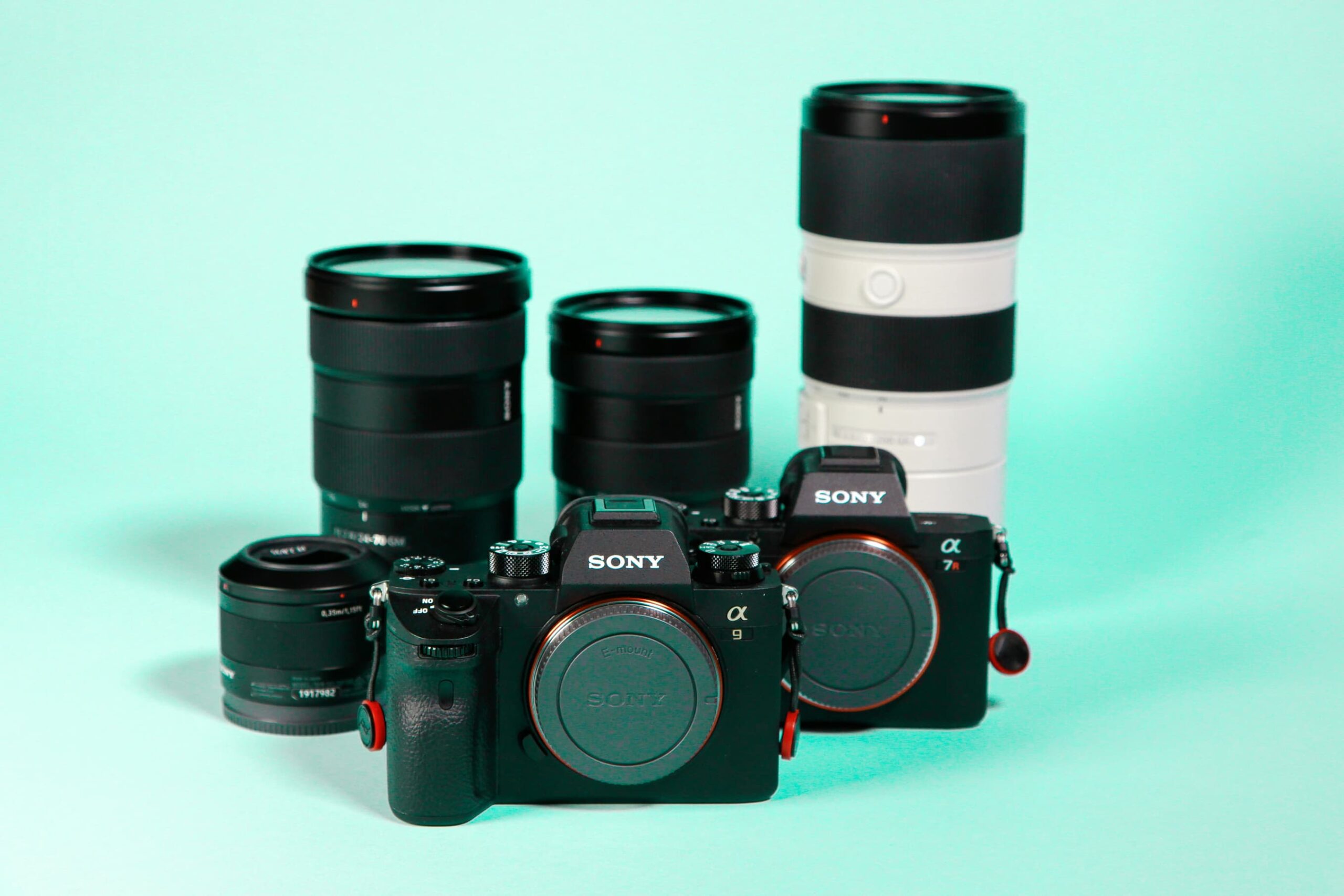
The lens often has a greater impact on the image than the camera body. It determines whether a landscape will fit into the frame, whether you can bring a distant bird closer, and whether the background of a portrait will be beautifully blurred. In this guide, we’ll look at the three most common types of lens – wide-angle, standard and telephoto – explain what focal length and aperture mean, and show you how to find the right lens for your camera.
| Type of objectivity | Focal length (full frame) | Suitable for |
|---|---|---|
| Wide angle lens | less than 35 mm, e.g. 16–28 mm | landscapes, architecture, interiors, the Northern Lights |
| Standard lens | 35–50 mm | street photography, travel, everyday life, environmental portraits |
| Portrait lens | 85–135 mm | portraits, with a beautifully blurred background |
| Telephoto lens | more than 135 mm, e.g. 100–400 mm | nature, birds, sport, events |
| Macro lens | usually 50–105 mm | insects, flowers, close-up product shots |
As my first lens A kit zoom lens, which usually comes with the camera, is suitable for most people, paired with a fast 50 mm fixed lens. Once you know what you’re photographing most often, add a wide-angle or telephoto lens accordingly.
A wide-angle lens allows you to capture as much of the scene as possible. A wide angle of view is ideal for landscapes, architecture and confined indoor spaces, and it emphasises perspective, which adds depth to your photographs. A fast wide-angle lens is also ideal for capturing the starry sky and photographing the Northern Lights the most important tool.
Example: The Sigma 16–28 mm f/2.8 DG DN Contemporary is a lightweight and compact wide-angle zoom lens for full-frame mirrorless cameras. Its constant f/2.8 aperture also performs well in low light.
The focal length of a standard lens on a full-frame camera is 35–50 mm, and its angle of view is similar to that of the human eye. Fixed standard lenses are often very fast, so they allow you to take photos in low light without a flash and create a blurred background (bokeh). Many photographers consider a 50 mm fixed lens to be the best first additional lens.
Example: The Sigma 50 mm f/1.4 DG DN Art is an extremely sharp standard lens. Its large f/1.4 aperture performs well in low light and isolates the subject from a soft background.
When your subject is far away, you’ll need a telephoto lens. It magnifies distant subjects and compresses the perspective, making the background appear closer to the subject. A telephoto lens is essential for nature and sports photography, and is also suitable for close-up portraits.
Example: The Sigma 100–400 mm f/5–6.3 DG DN OS Contemporary is a relatively lightweight super-telephoto zoom lens. The optical stabiliser (OS) helps you capture sharp images handheld even at long focal lengths, making it well suited to nature enthusiasts and budding sports photographers.
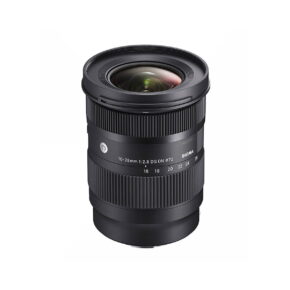
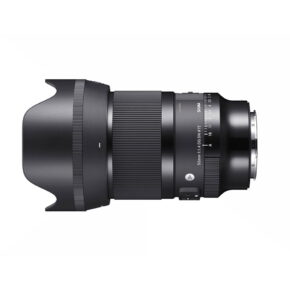
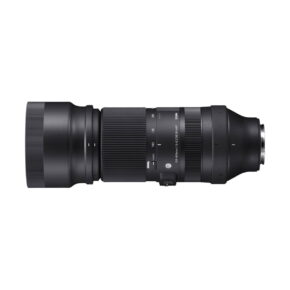
The example lenses are for Sony’s E-mount. The same models are also available for other mounts; please select yours from the product page.
Portrait lens It is usually a fast 85 mm fixed-focal-length lens. Many consider it the best portrait lens: facial proportions remain natural, and the background is heavily blurred. On an APS-C camera, the same effect can be achieved with a lens of around 50–56 mm.
With macro lens You can get right up close to your subject and capture a small subject in the frame at its natural size. Read more in the guide the most important tools for a macro photographer.
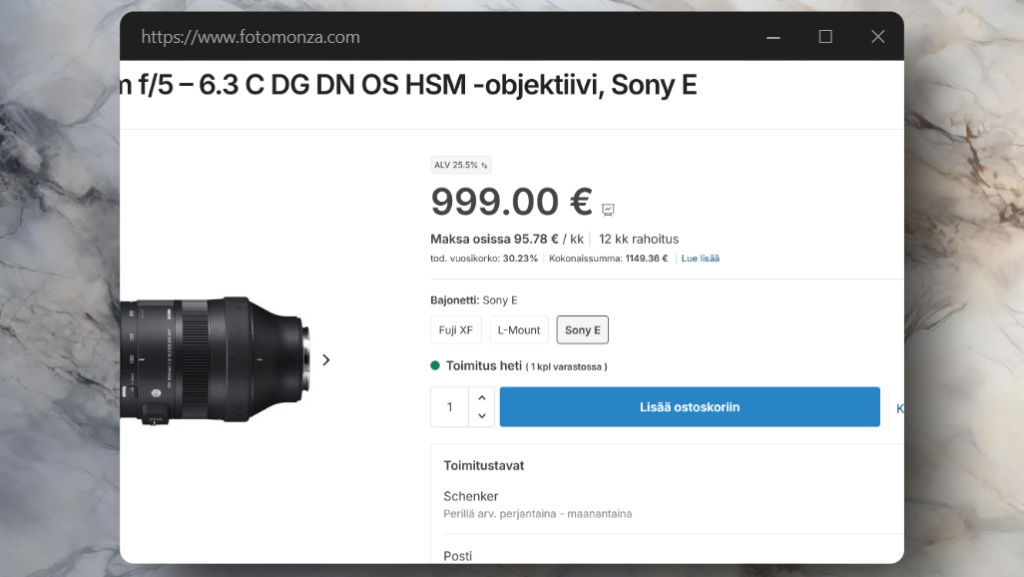
Bayonet (in English: lens mount) is the connection between the camera and the lens. The lens mount must be the same as that on the camera body, and mounts from different manufacturers are not compatible with one another. On Fotomonza.com, you can view the lens mount options on the product page as selection buttons.
| Camera brand | Mirrorless cameras | Older digital single-lens reflex (DSLR) cameras |
|---|---|---|
| Sony | E-mount: FE = full-frame, E = APS-C | A bayonet |
| Canon | RF = full-frame, RF-S = APS-C | EF = full-frame, EF-S = APS-C |
| Nikon | Z-mount (DX = APS-C) | F-mount (DX = APS-C) |
| Fujifilm | X-mount (APS-C), G-mount (GFX, medium format) | – |
| Panasonic, Leica and Sigma | L-bayonet | – |
| OM System and Panasonic | Micro Four Thirds (MFT) | – |
An adapter allows you to use lenses with different mounts, such as a Canon EF lens on a Sony mirrorless camera With the Sigma MC-11 adapter or with Canon’s own EF–EOS R adapter. This is a good solution if you’re switching systems gradually and don’t have the budget to replace everything at once.
An affordable way to try out a new focal length is second-hand lens. We inspect each one before it goes on sale, and they all come with a guarantee of at least 90 days. You can find all our new lenses in the section lenses.
Are you thinking of buying a second-hand lens? Read this first Checklist for buying a second-hand lens: How to spot mould, mist and a warped lens.
For most people, a good first additional lens is a fast 50 mm fixed lens (equivalent to approximately 35 mm on an APS-C camera). It’s affordable, performs well in low light and creates a blurred background, something a kit zoom lens cannot achieve.
A classic choice is an 85 mm f/1.8 or f/1.4 lens for a full-frame camera and around 50–56 mm for an APS-C camera. A 50 mm f/1.8 lens is a more affordable way to get started.
The f-number indicates the lens’s maximum aperture. The smaller the number, the more light the lens lets through and the more blurred the background becomes. For example, f/1.4 is considerably brighter than f/5.6.
The mount depends on the camera’s make and model; see the table above. For example, the Sony A7 and A6000 series use the E-mount, the Canon EOS R series uses the RF mount, and the Nikon Z series uses the Z-mount. If you’re unsure, just ask us and we’ll check it for you.
That’s fine. With Canon’s own EF–EOS R adapter, EF and EF-S lenses work on EOS R cameras, including autofocus and image stabilisation.
Welcome to our shop in Kouvola. You can try out the lenses with your own camera, and we’ll help you choose the right focal length and mount.